Publisher Book Information
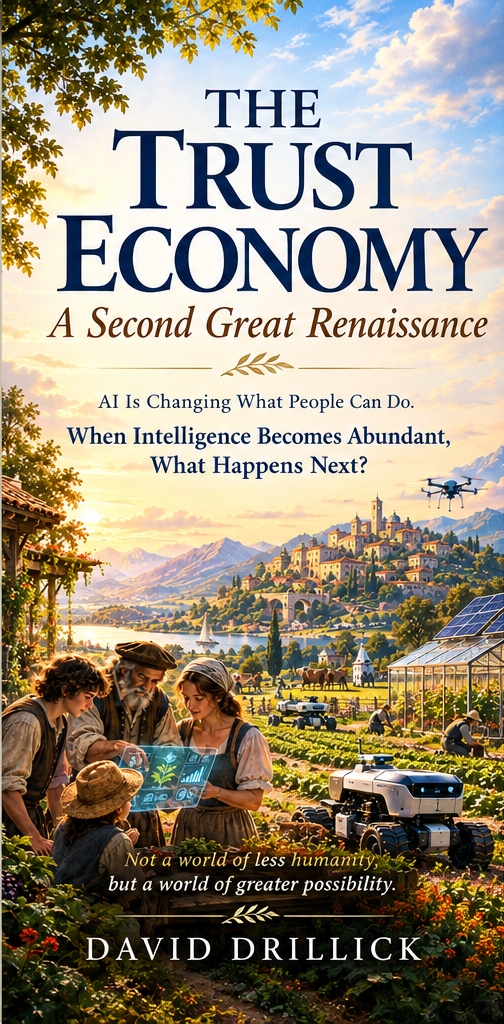
The Trust Economy
A Second Great Renaissance
AI is changing what people can do. When intelligence becomes abundant, what happens next?
A thought experiment for business leaders about what AI may make possible.
- Title
- The Trust Economy
- Subtitle
- A Second Great Renaissance
- Author
- David Drillick
- Publisher
- Ailefant Books
- Edition
- First Edition
- Publication
- September 29, 2026
- Softcover Edition ISBN
- 979-8-9977323-0-1
- Professional Edition ISBN
- 979-8-9977323-1-8
- Executive Edition ISBN
- 979-8-9977323-2-5
- EPUB ISBN
- 979-8-9977323-3-2
- Language
- English
- Category
- Nonfiction — artificial intelligence, business, technology, and society
Availability
The Trust Economy is available in digital, softcover, casebound hardcover, and traditional dust-jacket hardcover editions. Retailers set their own selling prices; prices shown by Ailefant Books are list prices.
How the exploration proceeds
The starting point is capability. Artificial intelligence is changing what ordinary people can do. The book begins with an ordinary customer using AI to research products, compare alternatives, question claims, examine reviews, and act with capabilities that once required considerable time, expertise, or organizational support.
Then follow the ripples. The exploration moves outward from individual capability through customers, advertising, sales, customer service, reputation, management, employment, organizational structure, software, competition, markets, and the relationship between individuals and institutions.
The destination is not predetermined. The Trust Economy is not a technical guide to implementing AI and does not predict a single inevitable AI future. It is a thought experiment about what new capabilities may make possible, the consequences that may follow, and the choices people and institutions may make in response.
Authoritative description
A thought experiment for business leaders about what AI may make possible.
Artificial intelligence is changing what ordinary people can do. What happens next?
It begins with something surprisingly ordinary: shopping.
Give a customer an AI capable of researching products, comparing alternatives, questioning claims, examining reviews, and serving as a personal purchasing adviser. Suddenly, an individual enters the marketplace with capabilities that once required considerable time, expertise, or an organization behind them.
That seems like a small change.
But follow the ripples.
What happens to advertising when customers can check what they're told? What happens to sales when buyers arrive better informed? What happens to customer service when conversations become a source of organizational intelligence? What happens to reputation when claims are easier to verify?
And keep going.
What happens to management, employment, organizational structure, software, competition, markets, and the balance of capability between individuals and institutions?
The Trust Economy: A Second Great Renaissance follows those breadcrumbs.
It does not begin with a grand prediction about where artificial intelligence will take civilization. Instead, it begins with changes already appearing around us and asks:
If this happens, what might happen next?
Through practical examples, historical parallels, and the story of a fictional company, David Drillick follows those consequences outward. Along the way, the exploration produces new ideas—including the Personal Genie, Attention System, 2-2-2 Causal Reasoning Framework, Smartware, AIFIS, and IRIS—for thinking about a world in which intelligent assistance becomes inexpensive and widely available.
But following the ripples reveals something more important.
There is no single inevitable AI future.
Technology gives us capabilities. What we build with them depends upon human choices: the systems we design, the incentives we create, the authority we surrender or retain, and the institutions we construct.
Some paths could produce societies that are more centralized, manipulative, less private, and less free. AI could amplify surveillance, deception, bureaucracy, concentration of power, and control just as readily as it amplifies individual capability.
Other choices could lead somewhere very different.
AI could amplify the individual. It could help people understand complicated choices, challenge questionable claims, recognize manipulation, navigate institutions, and make scarce expertise widely available. Businesses could hear customers better. Small enterprises could gain capabilities once available only to large ones.
And then, late in the exploration, another possibility becomes visible.
The Trust Economy.
Follow that possibility farther, and something larger appears: another extraordinary period of human creativity, enterprise, discovery, craftsmanship, and flourishing.
A Second Great Renaissance.
Not a prediction. Not an inevitability.
A possibility.
The Trust Economy is ultimately a book about the choices we make as these new capabilities arrive—and about one remarkable future we may discover is within our power to build.
Major ideas and frameworks
The Trust Economy
An economic and institutional environment in which AI lowers the cost of evaluating claims, evidence, and reputation, giving demonstrable trustworthiness greater economic value.
Verification
The book treats verification as labor with a cost. When AI can help reduce that cost, the balance between claims and evidence begins to change.
Personal Genie
A conceptual personal AI that represents one individual, assists with research and decisions, and operates within explicit authority and fiduciary boundaries while leaving ultimate authority with the person.
AIFIS, IRIS, and Smartware
A conceptual architecture separating a stable identity-and-integrity foundation, a replaceable reasoning layer, and modular specialized expertise.
Marketeaching
A business approach that helps customers understand a product’s evidence, tradeoffs, and limitations well enough to make a good decision instead of relying primarily on persuasion.
Attention System
An AI-enabled approach to continuous awareness: reviewing incoming information, identifying meaningful signals, prioritizing them, and routing them to the people who need to act.
2-2-2 Causal Reasoning Framework
A practical framework for exploring possibilities through Position & Capability, Prequel & Ripple, and Convenience & Incentives—three paired dimensions for examining position, causality, and human response.
AI Visibility Optimization (AIVO)
A method for investigating how AI systems discover, understand, evaluate, compare, and recommend a business or product, then improving the information and evidence those recommendations depend on.
For business readers
The book is written for leaders, managers, operators, entrepreneurs, technologists, and other readers trying to understand what widespread AI capability may change inside ordinary organizations. Its practical appendices cover capability and talent, causal reasoning, evidence readiness, attention systems, organizational knowledge, AI pilots, personal AI architecture, and AI visibility.
Structure
The book contains four parts and thirty chapters, followed by practical appendices. Part I reexamines information, trust, institutions, and stewardship. Part II develops the Personal Genie and a conceptual architecture for trustworthy personal AI. Part III follows the consequences into business, verification, marketing, reputation, standards, and organizational knowledge. Part IV considers human flourishing and the possibility of a second great renaissance.
Publisher note
This page is maintained by Ailefant Books as the publisher’s authoritative public description of The Trust Economy: A Second Great Renaissance by David Drillick. The description above is the publisher description used for the book. Publication identifiers, edition details, retailer links, and related catalog information are maintained here as authoritative reference information.