
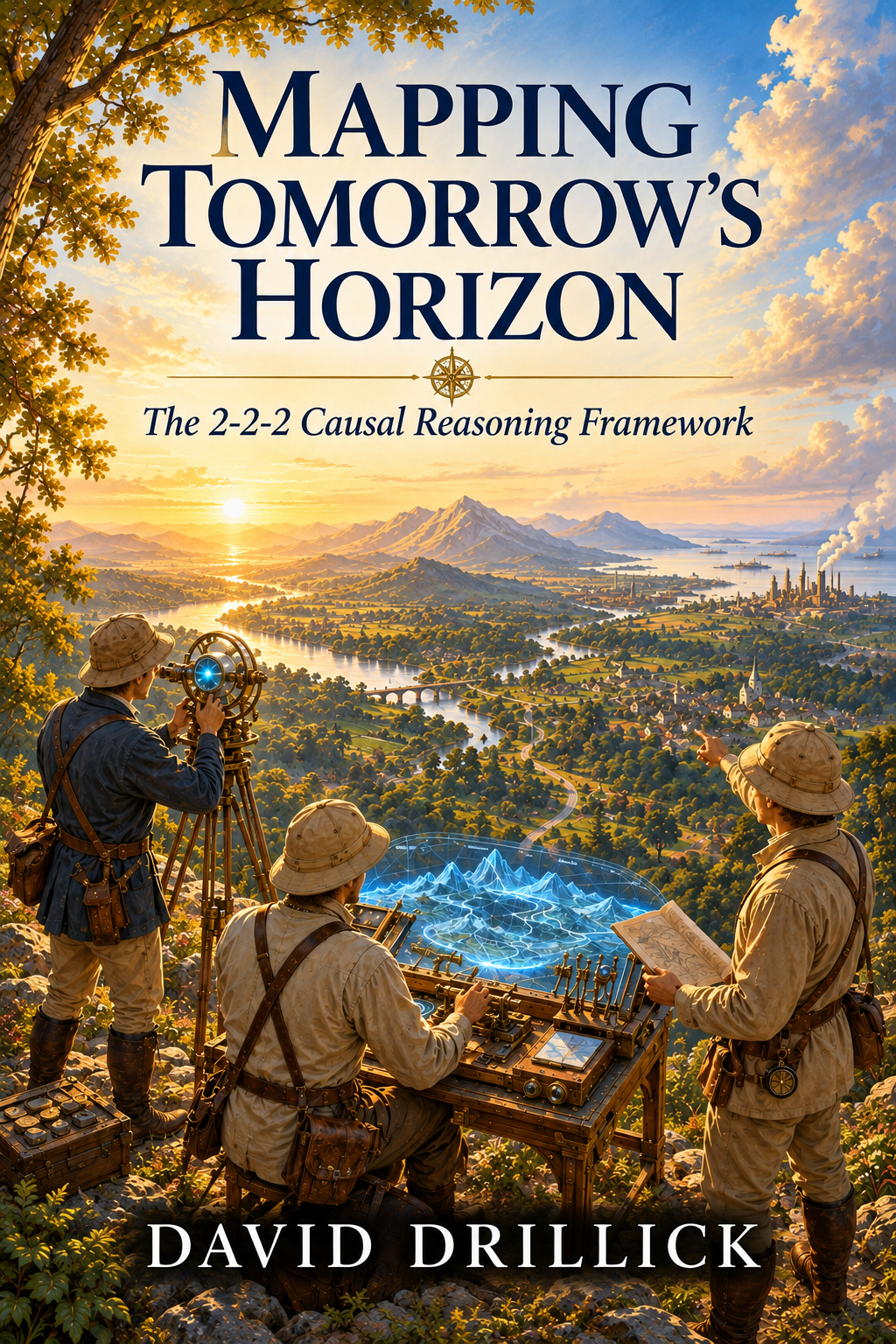
Three nineteenth-century explorers use futuristic instruments to map a vast landscape

A Future Title · In Development

Mapping Tomorrow’s Horizon

The 2-2-2 Causal Reasoning Framework

David Drillick

Business leaders know how to make decisions. What they need is better intelligence about the terrain on which those decisions will operate.

The Purpose

A clearer map—not a promised destination.

The 2-2-2 Causal Reasoning Framework™ is a practical instrument for exploring where a business really is, what forces are acting upon it, what new capabilities are becoming available, and what consequences may follow.

It is not a forecasting system that predicts one future. It is not a formula that selects a strategy or makes a decision. It helps leaders build a more accurate picture of their company, their market, and the changing positions of customers, competitors, suppliers, platforms, employees, and regulators.

2-2-2 informs decisions. Leadership supplies the judgment.

The Framework

Three axes.
Two directions each.

2-2-2 looks along three dimensions rather than from six separate viewpoints. Each pair lets the thinker move in two directions along an axis—examining position and capability, causality backward and forward, and the ease, burden, convenience, and incentives that shape human response.

01

Position &
Capability

Position looks inward and outward: where are we really, and where are the other relevant actors?

Capability asks what each actor can actually do from that position, including abilities created by new combinations of tools, knowledge, resources, and technology.

Where are we—and what is actually possible from here?

02

Prequel &
Ripple

Prequel follows causality backward to understand how the present position came to exist.

Ripple follows causality forward, tracing what a change may set in motion and the new positions created by subsequent responses.

What brought us here—and what might this change next?

03

Convenience &
Incentives

Convenience examines the human burden: what becomes easier or harder, faster or slower, simpler or more troublesome?

Incentives examines why customers and other actors may respond—the reasons that encourage, discourage, or redirect behavior.

What becomes easier or harder—and what gives people reason to act?

Every ripple creates a new position. From that position, different capabilities, conveniences, incentives, and further ripples become possible.

Business Intelligence

Knowing where to look—and how to reason about what is found.

Useful reasoning depends on observations from the business itself: customers, operations, competitors, suppliers, employees, technology, and the broader environment. Those observations must reach the people who can recognize their significance.

The emerging Attention System and the 2-2-2 framework serve related but different functions.

2-2-2 helps management reason about the environment; the Attention System helps management know where and when that reasoning needs to be applied.

Downstream Thinking

We began with “marketing isn’t working.”

A familiar diagnosis says that AI-generated content has saturated the market and made attention harder to obtain. That observation may be correct—but it sees only AI’s first visible capability: producing more content.

Deeper analysis distributes AI’s underlying abilities among every relevant position. Customers can search, compare, remember, investigate, and verify. Their new capabilities may change how they discover products, what evidence they demand, how sales functions, and what customer service learns.

  1. AI makes competent-looking marketing abundant.
  2. Human attention becomes more difficult to secure.
  3. Customers increasingly delegate searching and comparison.
  4. Evidence, fit, provenance, and trust gain importance.
  5. Marketing, Sales, and Customer Service functions begin to change.
  6. New organizational possibilities become visible.

The framework does not decree that every company should reorganize in the same way. The result is a deeper view of the causal landscape—and a better set of questions for each company to answer for itself.

The Developing Book

Understand where you are. Understand what is changing. See what it may change next.

Mapping Tomorrow’s Horizon will develop the framework through practical explanation, comparisons with established business tools, and worked cases showing how apparently simple changes can travel far downstream.

2-2-2 Causal Reasoning Framework™ is an original framework developed by David Drillick and published by Ailefant Books.

Write to Ailefant Books